

Menu

You're Invited to Gulfood 2026
Find us at Za'abeel Hall 2, Stand Z2-C3
What Importers Should Know About Beverage Regulations

Author
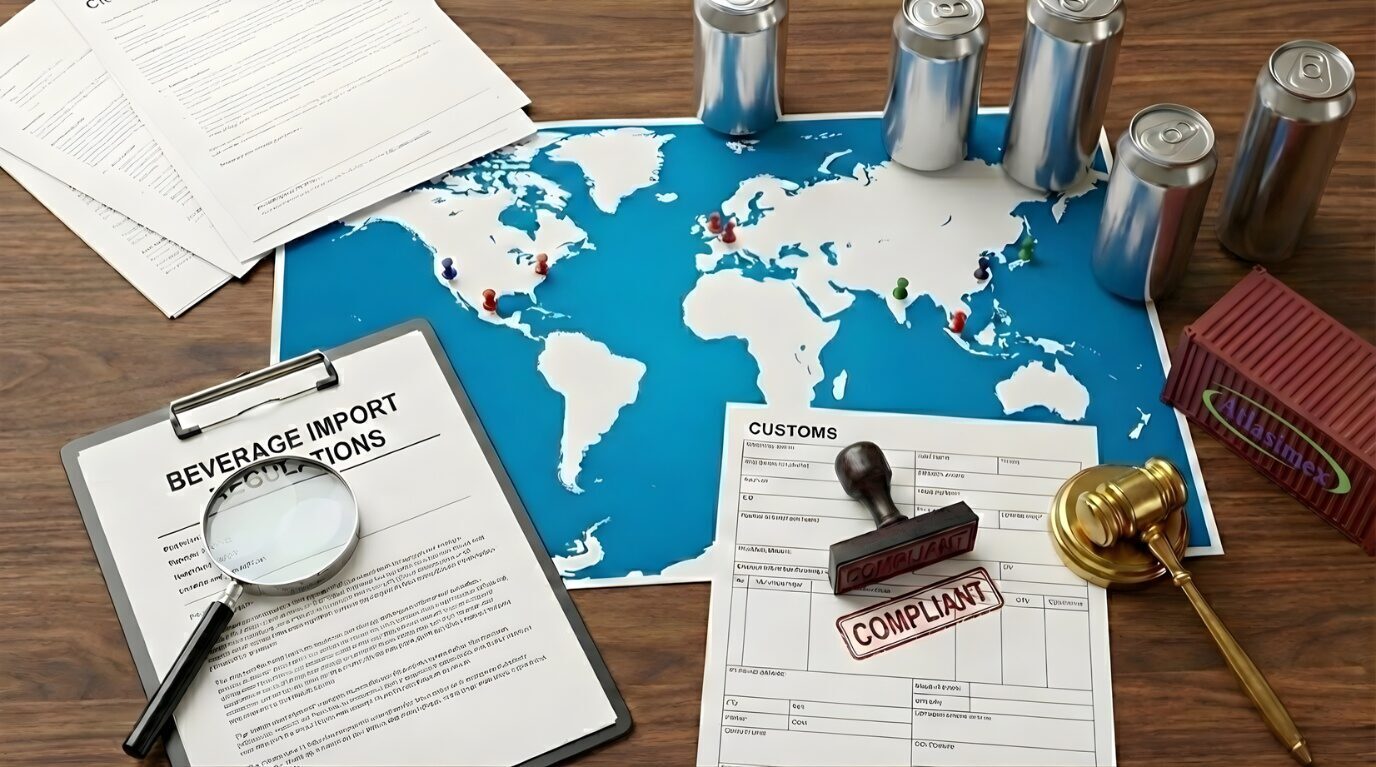
Compliance is King: Navigating the Legal Landscape of Beverage Importation
In the global beverage trade, a great product is only half the battle. The other half is ensuring that product can legally cross borders. For importers and distributors, regulatory non-compliance is a silent business killer—capable of causing expensive delays at port, forced re-labeling, or even the destruction of goods.
At Atlasimex, we export to over 21+ distinct markets, each with its own unique legal framework. Through this experience, we have identified the three critical pillars of compliance that every importer must understand before placing an order.
1. Labeling Standards & Language
Your can is your contract with the consumer, and local authorities strictly regulate what it says.
- Language Requirements: Most countries require ingredients and nutritional tables to be in the official local language. Stickers can sometimes be used for small test batches, but printed cans are often mandatory for mass retail.
- Nutritional Transparency: The format of the "Nutrition Facts" panel varies wildly (e.g., EU style vs. US FDA style). Using the wrong template can lead to immediate rejection by health inspectors.
2. Ingredient Restrictions & Limits
"Energy" is defined differently around the world. What is standard in one region may be illegal in another.
- Caffeine Caps: Many markets place a strict upper limit on caffeine content (often 32mg/100ml). Exceeding this makes the product a "supplement" or "medicine" rather than a beverage, triggering a completely different (and harder) set of import rules.
- Additive Bans: Certain colorants (like specific Red or Yellow dyes) or preservatives permitted in one continent may be banned or require "warning labels" in another.
3. Mandatory Certifications
Documentation is just as important as the liquid itself. Customs officials operate on paperwork.
- Health & Safety: Certifications like HACCP (Hazard Analysis Critical Control Point) and ISO are often prerequisites for obtaining an import license.
- Religious Compliance: For many of our key markets, Halal certification is not optional—it is a mandatory requirement for entry. This involves not just the final product, but a trace-back of all raw ingredients to ensure they meet religious standards.
The Atlasimex Advantage: We Handle the Paperwork
For our partners, we act as a compliance shield. Our export team provides full Export Documentation support, ensuring that every Bill of Lading, Certificate of Origin, and Analysis Report matches the exact requirements of your local customs authority. We adjust formulations and label designs before production begins, guaranteeing that when your container arrives, it clears customs smoothly and hits the market faster.
Tags
- Import Regulations
- Customs Clearance
- Food Safety
- Halal Certification
Share
Join our newsletter
Email address: Subscribe